
Interview conducted by Georg Isbaner, editor-in-chief of the Implantology Journal of OEMUS MEDIA AG, with Dr. Stefan König and Prof. Dr. Nejat Nizam, the developers of the i-LiNQ® product family, about the vision and objective of the new product development.
Published in the Implantology Journal 12/2021
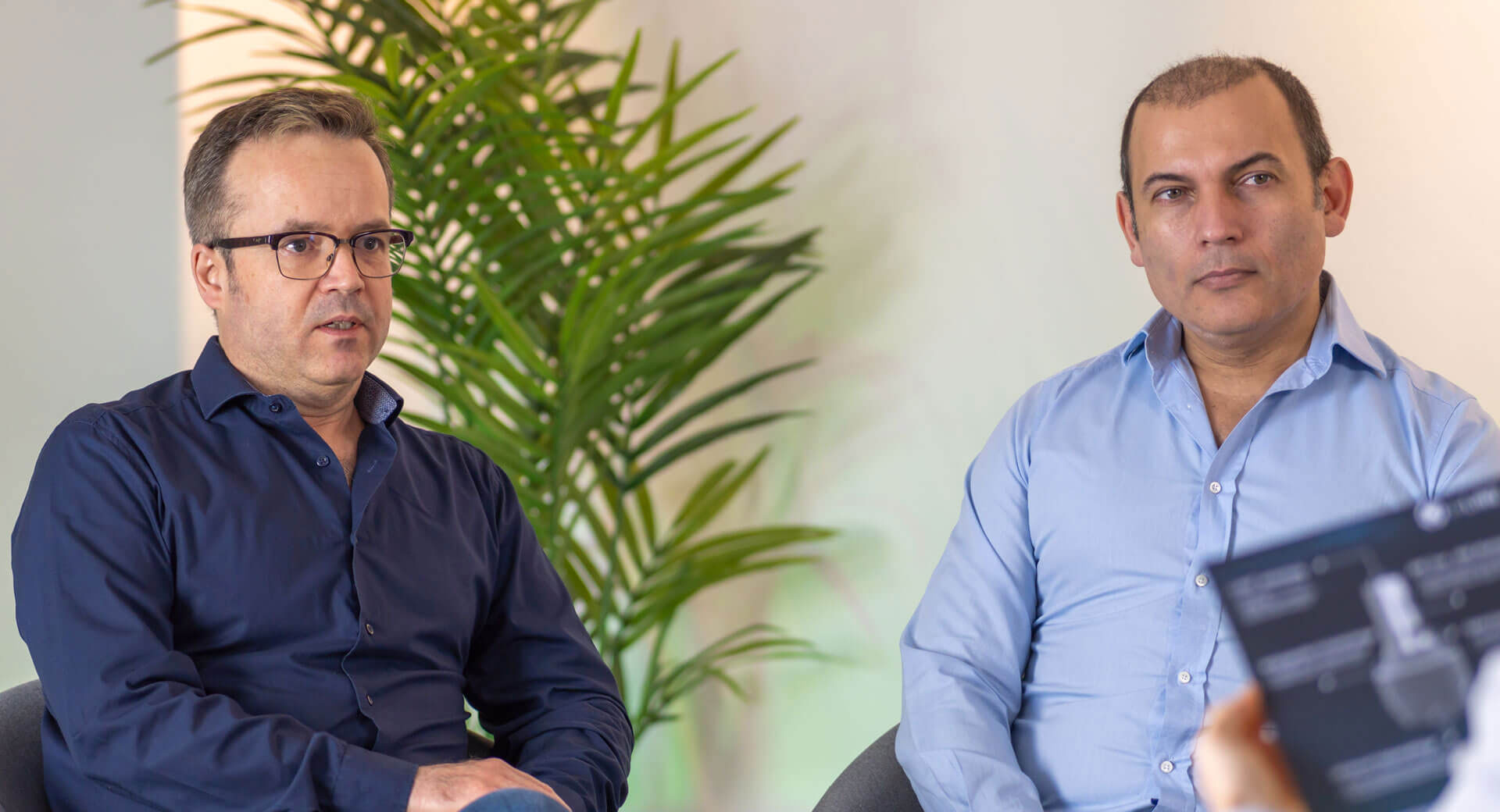
Dr. König and Prof. Nizam in conversation with Georg Isbaner.
Dr. König, Professor Nizam, you have been successful users and advocates of ultra-short implants with a plateau anchor design for many years. Over the past four years, with the help of Novodent SA, a globally active implant company from Switzerland, you have developed your own implant and prosthetics line called i-system and i-LiNQ®, which was presented to a wider audience for the first time at IDS 2021. The concept of ultra-short implants has existed for many decades. What exactly fascinates you so much about this exceptional treatment concept?
Dr. Stefan König: In short, I am less fascinated by the “ultra-short length” itself, but rather by the medical potential of the underlying biological and biomechanical relationships that make such extremely short implant lengths possible in the first place.
This biological and biomechanical potential can not only reduce the length of an implant, but, more importantly, help solve the main problem in implantology: effectively controlling peri-implantitis. I have observed precisely this in my own patient population over more than ten years using implants with plateau-anchor geometry. And this observation was the initial impetus for me to delve deeply into the question: How exactly must the implant abutment geometry be designed and the treatment protocol conceived to achieve maximum possible biological compliance? The result, through the combination of i-system and our new i-LiNQ® development, isan implant abutment configuration that we are convinced truly justifies the label "biological."
Although it's not a ceramic system, you refer to a biological concept in connection with i-system and i-LiNQ®. What do you mean by "biological" ?
Dr. Stefan König: Let me give you an example: Biologically speaking, every implant is also a kind of foreign body that can impair blood flow and bone nutrition. It is therefore a significant biological advantage to be able to reduce this "foreign body" to the necessary minimum. Because the shorter an implant is, the further crestal the network of blood vessels in the bone remains intact.
A direct consequence is an optimization of the oxygen supply to the peri-implant bone tissue, especially in the crestal area. And oxygen is the most effective medicine against all anaerobic bacteria and therefore also the most effective agent against peri-implantitis.
The questions that nature poses to us regarding whether an implant concept is biologically sound are far more complex than can be answered solely by considering the material or color of the implant. Therefore, the use of short and ultra-short implants is not merely a matter of available bone volume, but rather a biological consequence for all indications.
How does the i-LiNQ® fitinto this model of thinking, which you say is the very heart of your development work?
Prof. Dr. Nejat Nizam: It is generally known that the bone covering an implant should have a minimum thickness of 1 to 1.5 mm on the vestibular and oral sides, as otherwise the bone's nutritional status is insufficient to maintain its shape. If this bone thickness is not met, resorption of these bone areas is very likely. If we logically extend this biological principle, the question of maintaining this minimum bone thickness applies not only to the area lateral to the implant, but especially to the area above the implant, i.e., the area that forms the interface with the oral cavity. This has aesthetic significance with regard to adequate support of the soft tissue, and this crestal area is also the point of attack for bacteria that cause peri-implantitis.
From a biological perspective, it makes no sense to design implant geometries to be widest precisely where the transverse bone relief is narrowest. Right here, at the alveolar ridge, the implant abutment geometry should also have its narrowest diameter, mirroring the transverse bone relief. Only through such a geometrically designed arrangement can thin, tapered bone edges at the alveolar ridge be avoided. This ensures that bone layers remain adequately nourished and thus retain their shape under functional conditions. i-LiNQ®fulfills precisely this requirement. With a maximum diameter of three millimeters at the bony emergence, the maximum possible bone thickness is maintained around the emergence point, while still ensuring the necessary mechanical stability. Thin, tapered bone edges against the implant body are thus avoided. Furthermore, i-LiNQ®has a machined surface with a high surface quality, offering bacteria very little surface area for adhesion. The rough implant body, necessary for intraosseous anchoring, can be embedded deep in the bone, precisely where the bone has sufficient width.
But such a geometric arrangement would mean that the connection between the implant and i-LiNQ®would be located deep within the bone. Aren't you concerned that this could lead to bacterial pumping action between the components and thus bacterially induced bone loss?
Prof. Dr. Nejat Nizam: No. The technical connection between the implant and i-LiNQ®is achieved through a steep conical connection with a cone angle of 1.5° for the 2 and 3 mm diameter variants of the receiving shaft in the implant, or a 1.3° cone for the 2.5 mm shaft diameter.
It is a well-known principle in physics that when two metal components joined under pressure have a high surface quality, the electrons on the outer shells can form a stable, cross-laminated atomic lattice due to their attractive forces. In a physical sense, this creates a single piece of metal. This physical phenomenon is called "cold welding." To guarantee this high surface quality, both i-system implants and i-LiNQ® and i-LiNQ® abutments aremanufactured inSwitzerland with a maximum permissible tolerance of 0.005 mm. This is an absolute top value in the production of dental implants and abutments.
That's Swiss precision for you.
Dr. Stefan König: Exactly! But it's absolutely essential if you want to create screw- and cement-free connections in dental implantology. Intraorally applied cement for attaching crowns and bridges to implants is another factor that promotes the development of peri-implantitis. Therefore, it was important for us to create an abutment component with i-LiNQ®that enables an intraorally cement-free connection between the implant and the superstructure.
And equally essential if one wants to place these connections deep within the bone without negatively impacting the preservation of the surrounding bone. Our experience shows that the insertion depth of i-system implants, and thus the depth of the connection point, has no negative effects whatsoever. On the contrary: For the biological reasons mentioned above, crestal bone preservation is all the better the deeper the rough-surface implant is positioned in the bone and the longer the machined intraosseous portion of the i-LiNQ®is .
What is special about ultra-short implants, like the ones you are using?
Prof. Dr. Nejat Nizam: There are two aspects that arise from the plateau anchor geometry: a histological and a biomechanical one.
The histological aspect arises from the fact that, due to its geometry, an implant with exclusively horizontally arranged plateaus cannot be screwed in. This design thus avoids direct contact between the implant body and the adjacent bone tissue. The implant only makes contact with the osteotomy walls at the outer edges of the plateaus, thereby stabilizing its prosthetic axis. A blood clot collects in the spaces between the plateaus, forming a vascularized bone between them through a process called callus formation. This, in turn, means that the supplying vessels lie within the outer boundaries of the implant.
The biomechanical aspect resulting from the widely extending plateaus is the conversion of a large proportion of the typically present horizontal force vectors into vertical force vectors, which are smaller in absolute magnitude and also do not exhibit a gradient towards the theoretical biomechanical center of rotation in their respective orbits. Thus, the entire implant surface can be used more uniformly for load application.
As a result, the individual force moments transmitted to the bone are lower and therefore more physiological. They encounter exceptionally well-vascularized, oxygen-rich bone between the plateaus, which is thus highly adaptable to stress. And this biological-biomechanical relationship is the actual reason why implants with plateau-anchor geometry can be so efficient in their use of length.
That sounds very plausible. Nevertheless, there is a general skepticism towards short implants. Can you understand this skepticism, and how do you address it?
Dr. Stefan König: I can understand that 100 percent. The problem is that – even in scientific analyses – this crucial question of the underlying functional principle of each short implant is not sufficiently differentiated. Often, only the implant length is used as a differentiating criterion, not whether it's a screw design with high or low primary stability or a plateau-anchor geometry design. The biological principle is this: the smaller the gap between the implant body and the adjacent bone tissue, the more the bone regeneration mechanism shifts towards appositional bone growth, leading to avascular bone at the implant interface. In short: the higher the primary stability of an implant, the smaller the gap between the implant body and the bone tissue, and the more the
The balance shifts towards appositional bone growth. Conversely, the larger the gap between the implant body and the adjacent bone tissue, the more the balance shifts towards callus-mediated, i.e., highly vascularized, bone regeneration, the so-called Haversian bone morphology. And the special feature of the plateau-anchor geometry, as previously described, is that the oxygen-carrying blood vessels lie within the outer boundaries of the implant. In contrast, with appositional bone growth, they lie lateral to the outer boundaries of the implant.
The skepticism you mentioned can only be addressed by precisely and convincingly explaining these differences. We haven't reinvented the plateau implant; we've simply optimized Thomas Driskell's original design from the late 1970s and early 1980s in many details. Therefore, users can rely on more than three decades of successful clinical application and documentation of this design principle.
Prof. Dr. Nejat Nizam: Strictly speaking, i-LiNQ® issimply the logical implementation of what Thomas Driskell demanded from the outset: to insert the final abutment into the implant during uncovering and never remove it again. In practice, this "one time – one abutment" concept is not feasible with conventional abutments for many reasons. It would mean grinding down the abutments in the mouth, generating heat, or compromising aesthetics. It would mean that many of today's modern technologies would be inapplicable, and, most importantly, it would mean that we could not do without the intraoral application of cement.
With i-LiNQ®, we have realized the "One Time – One Abutment" concept in its purest form while simultaneously preserving complete prosthetic freedom. This is because i-LiNQ®shifts all prosthetic steps within the gingival level, thus maintaining the "osseous stability" surrounding the connection between the implant and i-LiNQ® in the bone during the prosthetic phase. As a result, prosthetically induced epithelialization of the sulcus is prevented, and the bone level present at the time of uncovering is preserved.

Presentation of the new and comprehensive user manual, which provides detailed information on the clinical procedure and theoretical background.
It is generally known that steep conical connections are difficult to transfer in their vertical dimension using the usual workflow between dentist and dental laboratory. At the same time, steep conical connections often lack indexing between the implant and the suprastructure, which also complicates prosthetic handling. How does this compare to i-LiNQ?®?
Dr. Stefan König: i-LiNQ® is – simply put – a double cone onto which the abutments are anchored using the same physical principle of cold welding as the i-LiNQ® is anchored in the implant. There is no anti-rotation mechanism between the i-LiNQ® and the implant itself, because once inserted, the i-LiNQ® is not removed from the implant. This is the essence of the "One Time – One Abutment" philosophy. Prosthetic indexing is achieved at the upper end of the prosthetic conical portion of the i-LiNQ® via a high-precision square locking mechanism. The free rotation between the i-LiNQ® and the implant provides unrestricted prosthetic flexibility in positioning the square during insertion of the i-LiNQ® into the implant .
Together with the 15° angled i-LiNQ®versions , we see no limits to prosthetic alignment. The square shape provides a precise three-dimensional reference point for transferring the impression from the patient's mouth to the model and back again. Our three-part impression posts feature a precise horizontal division between the post portion that remains in the patient's mouth when the impression tray is removed and the transfer component that remains embedded in the impression material. In the lab, the model is then screwed onto the base component and repositioned into the transfer component embedded in the impression material.
In summary, it should be noted that the unavoidable vertical inaccuracy that arises between the implant stem and the i-LiNQ® in a steep conical connection is completely absorbed within the i-LiNQ® . From that point on, only horizontal reference surfaces are used as the transfer reference in the transfer components. The user can therefore expect a transfer accuracy comparable to shim stock foils.
Which prosthetic indications can be addressed with i-LiNQ® ?
Dr. Stefan König: i-LiNQ®must be understood as a modular system. Currently available at product launch are the components "i-cement" for single crowns, "i-connect" for screw-retained bridges and bars, "i-conometric" for fricatively anchored bridges, and "i-ball" and "i-locator" for simple anchorage of removable prostheses. As you can see, we only need to manufacture a single component for each new application, since the different extension heights and shaft diameters are accommodated by i-LiNQ®using a single, uniform connecting cone.
This gives us extremely high flexibility for further developments. We are currently working on the digital product line. In the near future, however, we also plan to offer prefabricated anatomical abutments, as well as CAD/CAM-milled custom abutments.
Another vision I've had for a long time is the treatment of patients with a history of implantology: i-LiNQ® cantheoretically be adapted to a wide variety of implant systems. This offers patients with different existing implants in the same jaw a uniform prosthetic platform, which would greatly simplify new prosthetic restorations and simultaneously enable access to cementless prosthetics. So you see, Mr. Isbaner, we still have a lot planned!
Immediate loading concepts are increasingly coming into focus in implantology today. Can i-system implants be loaded immediately?
Prof. Dr. Nejat Nizam: Immediate loading is not possible with the classic plateau-anchor geometry, and there is no reliable scientific data to support this. The reason immediate loading is not possible here is that classic primary stability is precisely what is to be avoided in order to achieve the biological goal of keeping the so-called "healing chambers" between the plateaus open. Only by keeping these healing chambers open can a Haversian, highly vascularized bone morphology be enabled through callus formation.
But here, too, we have developed a solution that will delight many users: Based on the i-LiNQ®connection geometry, we have developed an implant that combines the two worlds of "primary stability" and "healing chamber design". The implant's name is as simple as it is logical: i-LiNQ®Implant.
The i-LiNQ® implant is a single-piece implant that heals transgingivally and features a wide, bionic thread design that achieves its primary stability in the osteotomy through vertical compression at the outer edges of the thread. Simultaneously, the drilling protocol between the osteotomy wall and the implant body keeps the healing chambers open, allowing a blood clot to initially collect. This clot is then remodeled into highly vascularized bone in the same way as with the classic plateau design. Therefore, I can answer your question about the possibility of immediate loading with a clear "YES" for the i-LiNQ® implant .
Are i-system, i-LiNQ®and i-LiNQ®Implantalready approved for the German market, and how, when and where can interested parties take a closer look at i-system?
Dr. Stefan König: Naturally, all products from Novodent SA, our industrial partner from Switzerland, have unrestricted CE marking, not only for Germany but also for the entire Western and Eastern European region. FDA approval is imminent. Compliance with all requirements stipulated by the MDR 2017 is a particular focus for Novodent SA, which is also a member of the Swiss Medtech Association and therefore subject to the strictest regulations and requirements from that body as well.
All interested colleagues can take a look at i-system and i-LiNQ® from spring 2022 onwards at our roadshow, which will take us to many cities in Germany, Austria and Switzerland.
Secondly, at our ImplantConcept training center in Bochum, where we offer both theoretical and practical courses. Or, even more simply, we welcome inquiries from many colleagues who are interested, and we invite them to observe our work in our practice. Further information can, of course, also be found on our website www.implant-concept.com, which also features a user-friendly online shop.
One last question: What does the "i" in front of your products stand for?
Dr. Stefan König: (laughs) For “innovation”, of course!
Thank you for the conversation.
Dr. Stefan König, Prof. Dr. Nejat Nizam: Thank you.