


The vast majority of all dental implants essentially follow a uniform design and form language. The analogy to the natural root of the tooth is unmistakable.
Unfortunately, from a biological perspective, this design principle results in implants being thickest where the jawbone is typically thinnest: at the point where it emerges from the bony alveolar ridge. Thin, tapering vestibular and/or oral bone walls are the geometric consequence, leading to the well-known negative biological effects.
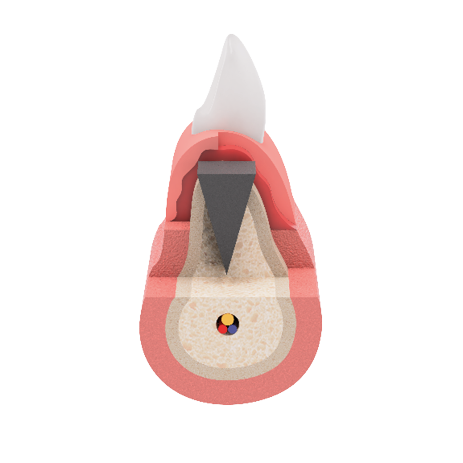
The vision of an anatomically conforming implant design with a significantly reduced emergence profile makes the implant thinnest where the bone is thinnest. Thus, in the vast majority of cases, even with narrow transverse bone profiles, the implant emergence lies within the skeletal envelope, significantly reducing the need for and/or extent of lateral augmentations. Depending on the chosen implant diameter, this provides up to 50% more space for crestal bone and efficiently increases the protective distance to the periodontal tissues of adjacent teeth.
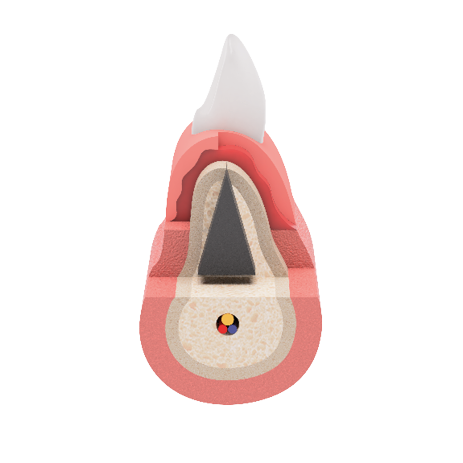
The fundamental change in the geometric arrangement of the platform shift chosen here results in a thick bone layer beneath the abutment, effectively promoting the development of a good biotype in the soft tissue surrounding the implant. Combined with the high biological permeability of the bony anchorage structure, i-LiNQ®Implant represents a new design approach that can achieve improved blood, nutrient, and oxygen supply to the alveolar ridge.
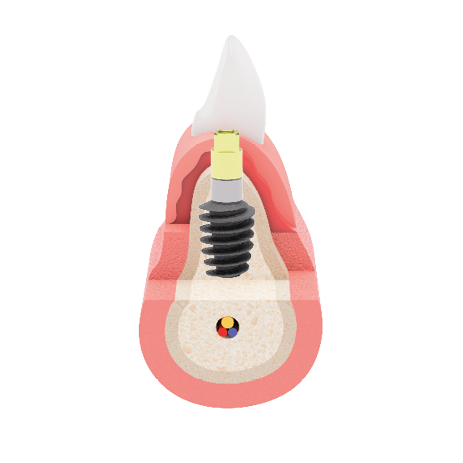
At the same time, a modification of the connection mechanism significantly reduces the prosthetically induced co-factors of peri-implantitis, namely cement residues and bacterial pump effect (which account for approximately 60% of all causes of peri-implantitis in the literature).
In summary, from a scientific point of view, it therefore seems justified to speak of a new biological design and form language in dental implantology.
The presentation aims to discuss the effects of this scientifically based development work from both a theoretical and a clinical perspective, and to present it in light of reality.
We cordially invite you…
…specifically, a special workshop that explores a new, biologically oriented approach to design and form. The aim is to understand and shape the interplay of technology, material, and biology in such a way as to achieve greater biological efficiency and sustainability in the implantological context.
The focus is on the i-LiNQ® philosophy, which translates functional anatomy, natural aesthetics, and biocompatibility into a unified design language. You will learn how conscious design and constructive principles create a new level of understanding between implant, tissue, and function.